COLLECTING GUIDE
Plan a Pokémon card binder
Lay out a binder before you sleeve a single card: choose the pockets, sort a collection into pages, and see which pockets are still empty.
Match the binder on your shelf
Choose the pocket grid of the binder you own: 4, 9, 12 or 16 pockets a page, or any grid up to 6 by 6. Pages open in spreads the way a real binder does, with the first and last page on their own.
Fill it from a collection
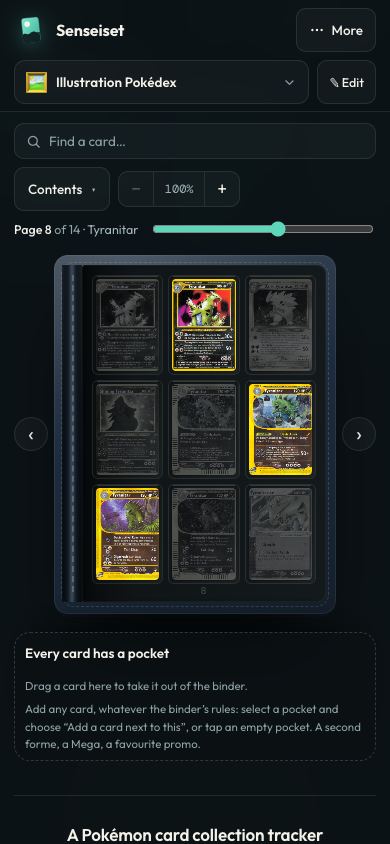
A binder takes its cards from one of your collections: a set, a Pokémon’s evolution line, an illustration Pokédex, or everything you own. Choose a pocket for every card, or one pocket per Pokémon. Cards you do not own yet show faded or as a silhouette, so the gaps are easy to see.
Sort it once, not card by card
Lay the binder out in set order, by Pokédex number, by name, by release date or by value. By Pokémon in your own order puts, say, every Larvitar first, then Pupitar, then Tyranitar, with each Pokémon’s cards oldest first. Start each set, generation or Pokémon on a new page if you like.
Several collections in one binder
A big binder can hold several sections, each from its own collection and in its own order. Every section starts on a new page, and moving a section carries its pages with it, so the rest of the binder stays as you arranged it.
Keep it tidy as the collection grows
New cards wait in the tray until you place them; adding one moves the cards after it along only as far as the next empty pocket. Keep a pocket empty on purpose to start a new page, and add a card by hand when you want one the binder’s rules would leave out, such as a second form.